Attraction

Deir el-Medina

The village of the men who cut and painted the royal tombs — the most completely documented community to survive from the ancient world.

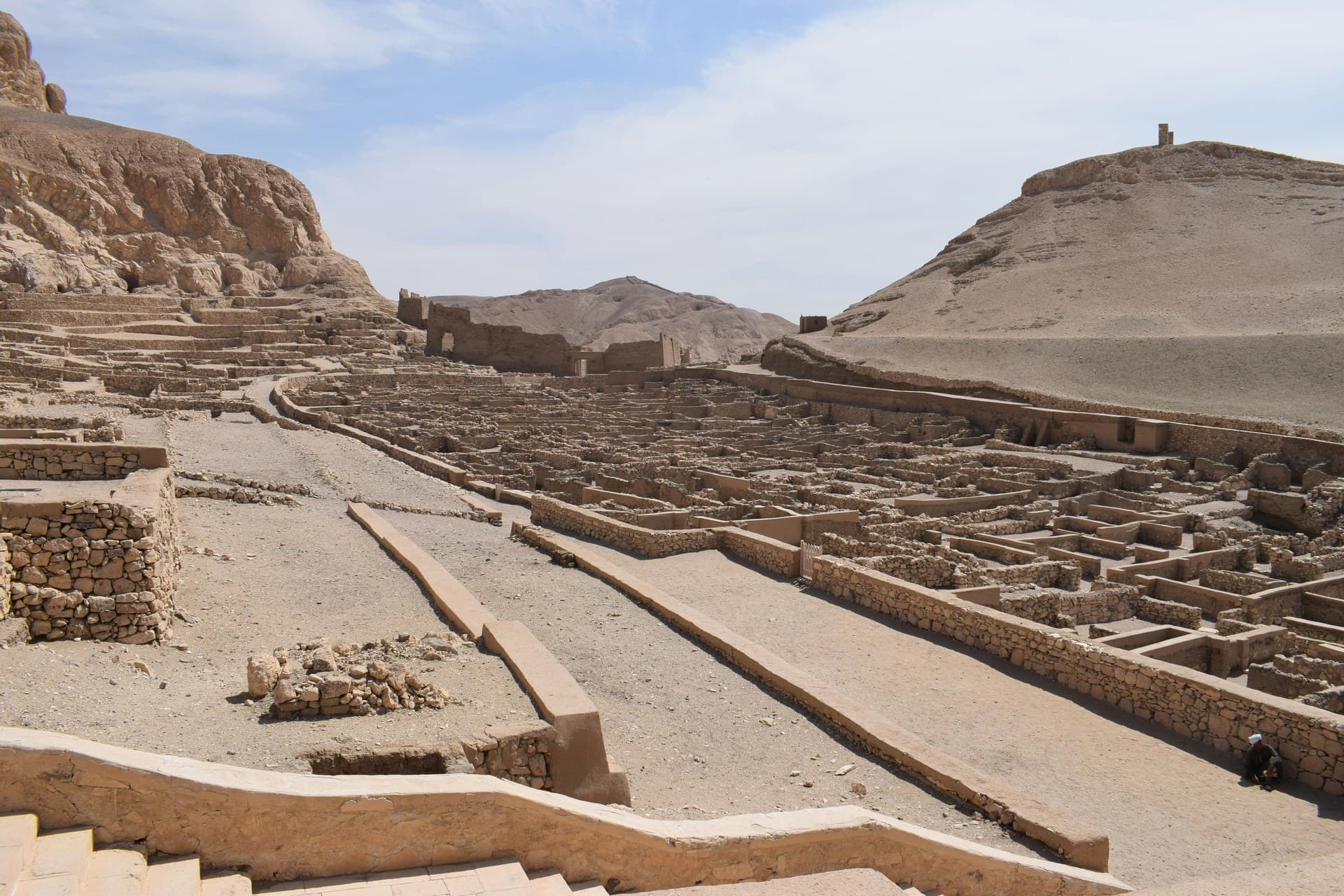
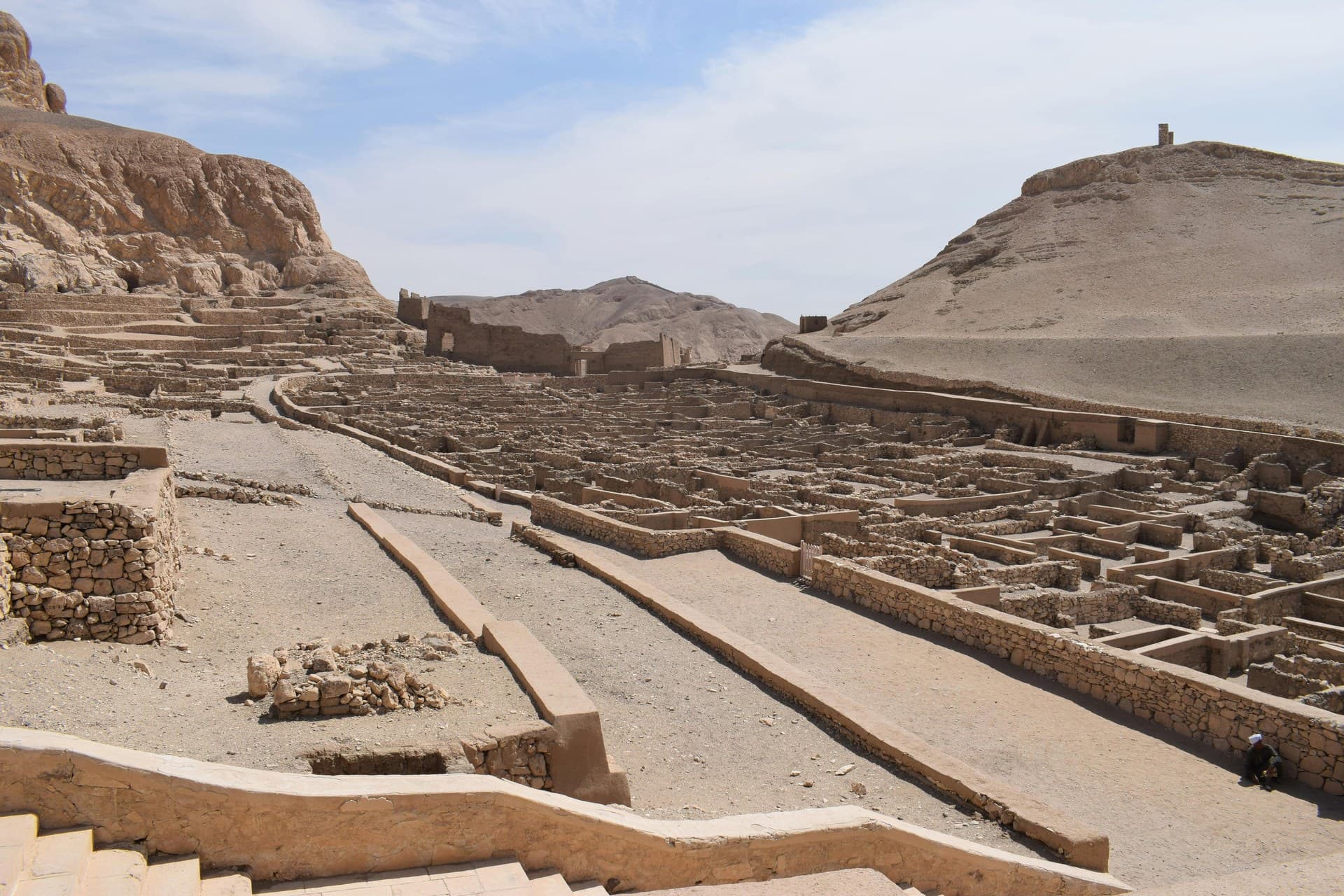
The excavated street and stone house walls of the workmen's village at Deir el-Medina below the Theban hills
Archaeological siteLuxor

Overview

Deir el-Medina is a walled village of small stone-and-mudbrick houses in a dry bay on the Luxor west bank, between the Valley of the Queens and the Ramesseum. You can walk the length of its single main street in a couple of minutes.

The men who lived here cut and decorated the tombs in the Valley of the Kings and the Valley of the Queens. They were craftsmen, not slaves — draughtsmen, sculptors, plasterers and painters, housed together and paid in rations.

Why visit Deir el-Medina

No other site in Egypt tells you about ordinary life this well. The villagers were literate, they wrote on limestone flakes and broken pottery because papyrus was expensive, and they threw the flakes into a pit. Thousands survive. They record work rosters, sick days, borrowed tools, marriage disputes, wills, complaints about a foreman, a dream book, and love poems. Almost everything specific that is known about how an ancient Egyptian household actually functioned comes out of this one village.

They also recorded the first documented strike in history. In year 29 of Ramesses III the rations failed to arrive, and the workmen downed tools and sat outside the mortuary temples until they were paid. The account of it was written down here.

And they built their own tombs on the slope above the village. These are small, and because the men who cut them decorated tombs for a living, the painting is superb. The tomb of Sennedjem is the one usually named, and it is as vivid as anything in the royal valleys, at a fraction of the scale.

History of Deir el-Medina

The village was founded in the early 18th dynasty and occupied for roughly four hundred years, through to the end of the 20th dynasty, when work on the royal tombs stopped and the community dispersed.

It housed something like sixty to seventy families at its height. The workforce was a single crew divided into a right side and a left side, each under its own foreman and its own scribe — terminology borrowed from the crew of a ship.

A Ptolemaic temple to Hathor and Maat stands at the northern end of the site. It was later taken over as a Coptic monastery, and that is where the modern name comes from: Deir el-Medina means the monastery of the town.

Sennedjem's tomb was opened intact in 1886, its painted chamber sealed since the 19th dynasty. An Italian mission under Ernesto Schiaparelli found a second undisturbed burial in 1906 — Kha, an overseer of works, and his wife Merit, with their furniture, linen and tools still in place. That household is in Turin now.

Bernard Bruyère then dug here for the French institute in Cairo from 1922, clearing the houses, the cemeteries and the great pit north of the village — a shaft sunk as a well, abandoned dry, then used as a dump. It held thousands of inscribed flakes.
What to see at Deir el-Medina

  • The village street and house plans, still legible at floor level
  • The tomb of Sennedjem, small and brilliantly painted
  • The tomb of Inherkhau, with some of the best-preserved colour on the west bank
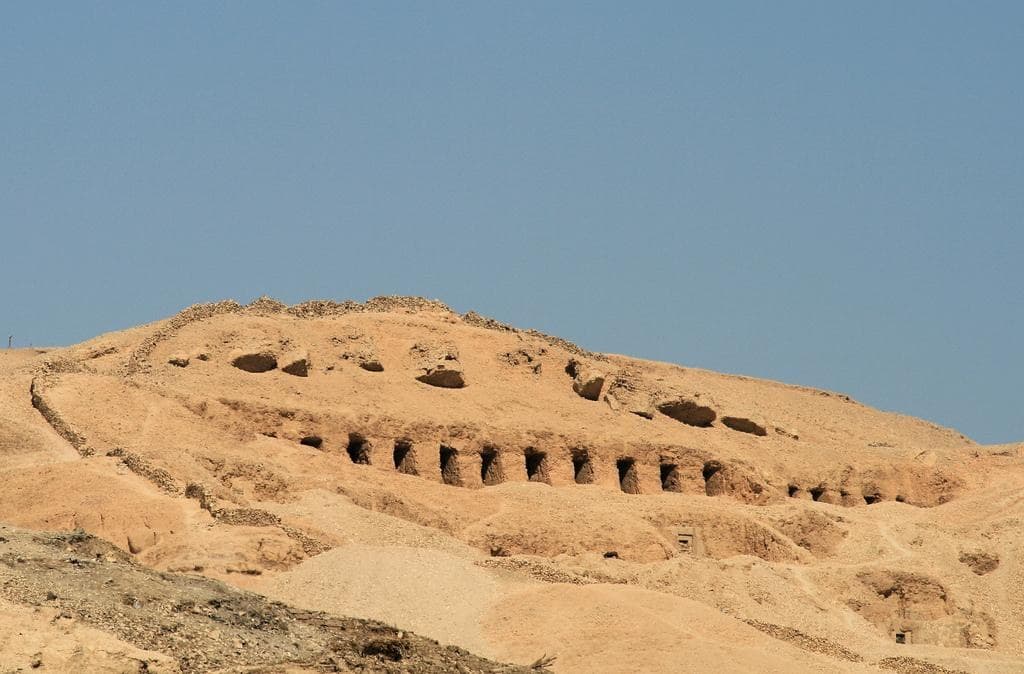
  • The workmen's own small mud-brick tomb pyramids on the slope above, once crowned with inscribed limestone pyramidions
  • The Ptolemaic temple of Hathor at the north end of the enclosure
  • The tomb of Pashedu, with its owner kneeling to drink beside a date palm
  • The great pit north of the village, sunk as a well and filled with discarded ostraca

Best time to visit Deir el-Medina

Morning. The bay it sits in has no shade at all and holds heat through the afternoon.

Opening Hours and Tickets

Opening hours: Daytime hours with seasonal variation.

An admission ticket for the site is bought at the gate. The decorated tombs are ticketed separately and not all are open at once — check what is available on the day.

Opening hours and ticket prices may change. Please confirm the latest details before visiting.

How to get to Deir el-Medina

On the Luxor west bank between the Ramesseum and the Valley of the Queens, reached with a driver as part of a west-bank circuit.

Nearby Attractions

Tours that include Deir el-Medina

Luxury Cairo, Luxor and Aswan Package

Luxury Cairo, Luxor and Aswan Package

An upscale private journey that combines Cairo highlights, a polished Luxor stay, and a refined Aswan finish.

Classic Cairo and Luxor Private Tour

Classic Cairo and Luxor Private Tour

A first-time Egypt itinerary that balances Cairo icons with Luxor's major temple sites over one well-paced private journey.

06 Days Cairo to Luxor Tour

06 Days Cairo to Luxor Tour

Experience the essence of Egypt in just six days on this immersive journey from Cairo to Luxor. Begin in the capital, where you’ll stand before the legendary Pyramids of Giza, explore the Grand Egyptian Museum, and wander through the historic Citadel and the lively Khan El Khalili Bazaar. Then, fly south to Luxor to uncover the monumental temples of Karnak and Luxor, glide above the ancient city in a hot air balloon, and walk through the Valley of the Kings. This thoughtfully designed itinerary combines expert guidance, seamless travel, and a perfect balance of history and culture for an unfor

4 Night Luxor to Aswan Nile Cruise

4 Night Luxor to Aswan Nile Cruise

A classic Nile cruise itinerary with temple visits, river views, and a comfortable four-night rhythm.

4-Day Nile Cruise from Aswan to Luxor

4-Day Nile Cruise from Aswan to Luxor

Set sail on a captivating 4-day Nile cruise from Aswan to Luxor, where the ancient world unfolds before your eyes. Journey along the legendary Nile River and uncover Egypt’s most iconic temples and monuments. Begin in Aswan with visits to the High Dam and the enchanting Philae Temple, then continue to Kom Ombo and Edfu to explore magnificent sanctuaries dedicated to ancient gods. As you sail northward, reach Luxor—the open-air museum of Egypt—home to the grand Karnak and Luxor Temples and the royal tombs of the Valley of the Kings. With expert-guided tours, comfortable accommodations, and full

4 Day 3 Night Nile Cruise from Aswan to Luxor

4 Day 3 Night Nile Cruise from Aswan to Luxor

Set sail on a remarkable 4-day, 3-night Nile cruise from Aswan to Luxor, where the grandeur of ancient Egypt unfolds before your eyes. Journey along the legendary Nile River aboard a comfortable cruise ship, visiting some of the most iconic archaeological sites in the world. Discover the enchanting Temple of Philae in Aswan, the twin sanctuaries of Kom Ombo, and the magnificent Temple of Horus in Edfu. Continue to Luxor to explore the Valley of the Kings, the Temple of Hatshepsut, and the colossal statues of Memnon on the West Bank, before concluding your adventure at the awe-inspiring Karnak

Travel Tips Before Visiting

Check at the gate which tombs are accessible. The village is the point, but the decorated tombs are the reason to come, and not all of them are open at any one time — individual tombs close for conservation work. The tombs are small and steep. Access is down a short shaft with a ladder-like stair. Anyone uneasy in tight spaces should know that before descending. Go with the story in your head. Without knowing who lived here it reads as low walls in the sand. With it, it is the one place on the west bank that records ordinary working life rather than royal death. There is almost no shade and very little on site. The village lies in a closed bay in the hills that holds the heat, and there is not much beyond the gate and the parking. Bring water and come early. Take the slope above the village slowly. The path up to the workmen's own chapels and their small brick tomb pyramids is short but loose underfoot.