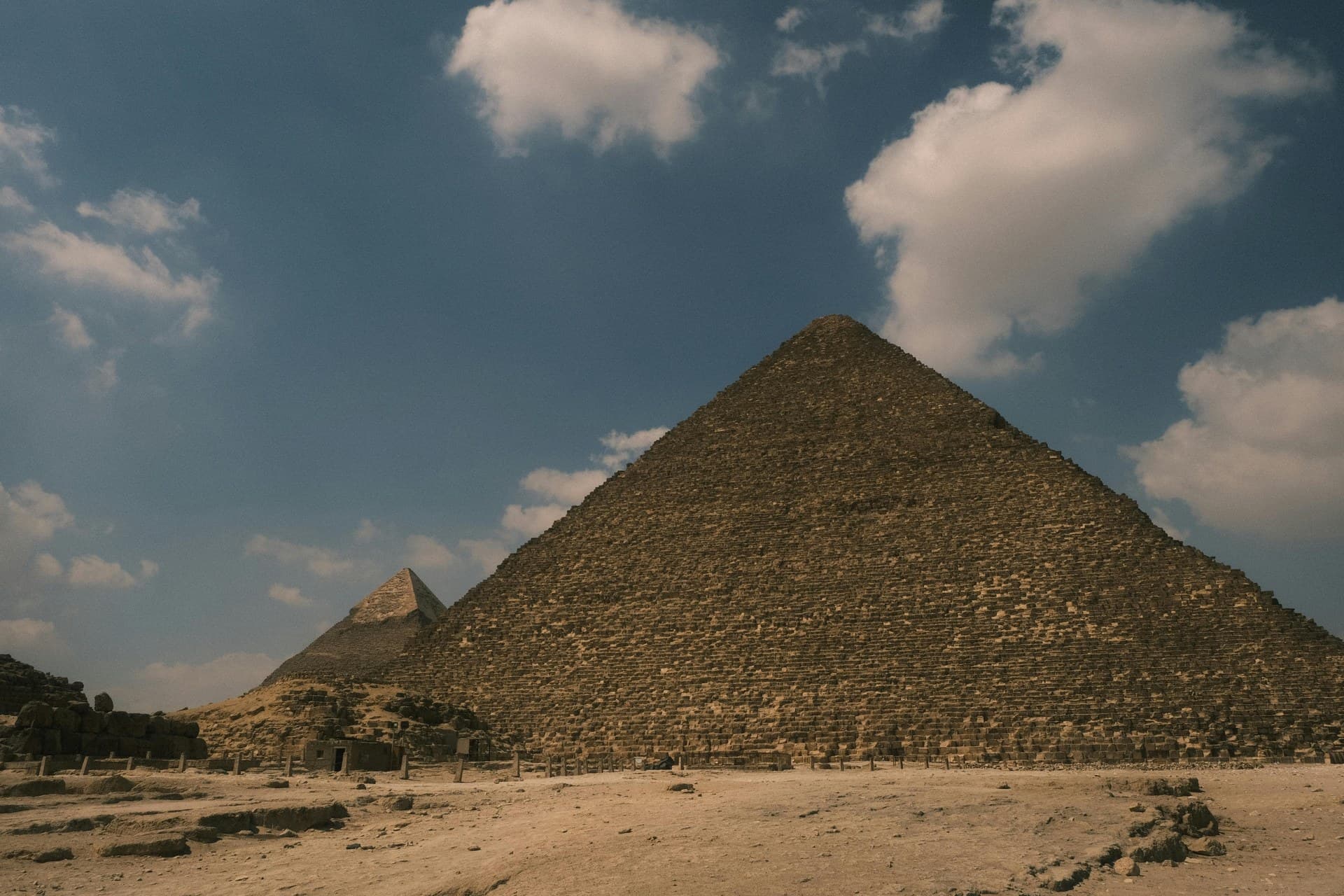
The Giza pyramids are the famous three, and they deserve to be. But they are the end of a story, not the whole of it, and the rest of that story is within an hour's drive.
The pyramid field runs for roughly seventy kilometres along the desert edge west of the Nile, from Abu Rawash in the north to Meidum in the south. If Giza felt crowded, everything else on that line will not.
Saqqara — where it started
The Step Pyramid of Djoser at Saqqara is the oldest large-scale cut-stone structure anywhere in the world, built in the 27th century BC and traditionally credited to Imhotep.
It began as a flat-topped mastaba — a rectangular tomb — and was enlarged upward in stages into six diminishing tiers. You can read the design changing its mind in the masonry. Everything at Giza is descended from that decision.
But the tombs are the reason to give Saqqara a morning rather than an hour. Several Old Kingdom mastabas here keep their carved and painted wall scenes: cattle counted, boats built, fish gutted, musicians playing. After the bare granite chamber inside Khufu's pyramid, the contrast is startling.
The Serapeum is the other thing — a rock-cut gallery of colossal granite sarcophagi that held the mummified Apis bulls, each cut from a single block.
Dahshur — where it was solved
Twenty minutes further south, Dahshur holds two pyramids built for the same king, Sneferu, within one reign. Between them they are the most instructive ruins in Egypt.
The Bent Pyramid rises at a steep angle for about half its height and then abruptly shallows out. The usual reading is that the builders found the original slope unstable and finished at a safer angle rather than starting again. You are looking at an engineering correction, frozen mid-build, from 4,600 years ago. It also keeps more of its original outer casing than almost any other Egyptian pyramid.
The Red Pyramid, a short distance north, is the answer: the first large pyramid built successfully at a shallow angle from the ground up, and the direct prototype for Khufu's.
It is also the best pyramid in Egypt to go inside. The descent is long and steep, but the chambers at the bottom are corbelled — walls stepping inward course by course to a high narrow ceiling — and there is usually no queue at all.
Why this makes Giza better, not redundant
Seeing Saqqara and Dahshur first, or on the same trip, changes what Giza looks like. The Great Pyramid stops being an isolated marvel and becomes the last and best iteration of a design problem three generations of builders worked on in public.
It also answers the question everyone silently carries around Giza — how did they do this? — because at Saqqara you can see the earlier, rougher attempt, and at Dahshur you can see the failure.
How to fit them in
Saqqara and Dahshur are a single half-day with a driver, and they pair naturally. Memphis, the ancient capital itself, is on the same road and takes twenty minutes — an open-air yard with a fallen colossus of Ramesses II.
The practical shape is: Giza and the Grand Egyptian Museum on one day, Saqqara and Dahshur on another. Our Cairo day tours run both.
If you only have one extra day in Cairo, this is what to do with it — see the two-day Cairo plan for how it fits.
Practical notes
A few things worth knowing before you go:
- Saqqara is spread out — keep your driver with you rather than walking between clusters over soft sand.
- Which tombs are open rotates for conservation. Ask at the entrance and have a second choice.
- There is almost nothing on site at Dahshur — no café, minimal shade. Bring water.
- Go in the morning. Both sites are exposed desert with no shelter between monuments.
- If you want to enter a pyramid anywhere in Egypt, do it at the Red Pyramid rather than queueing at Giza.