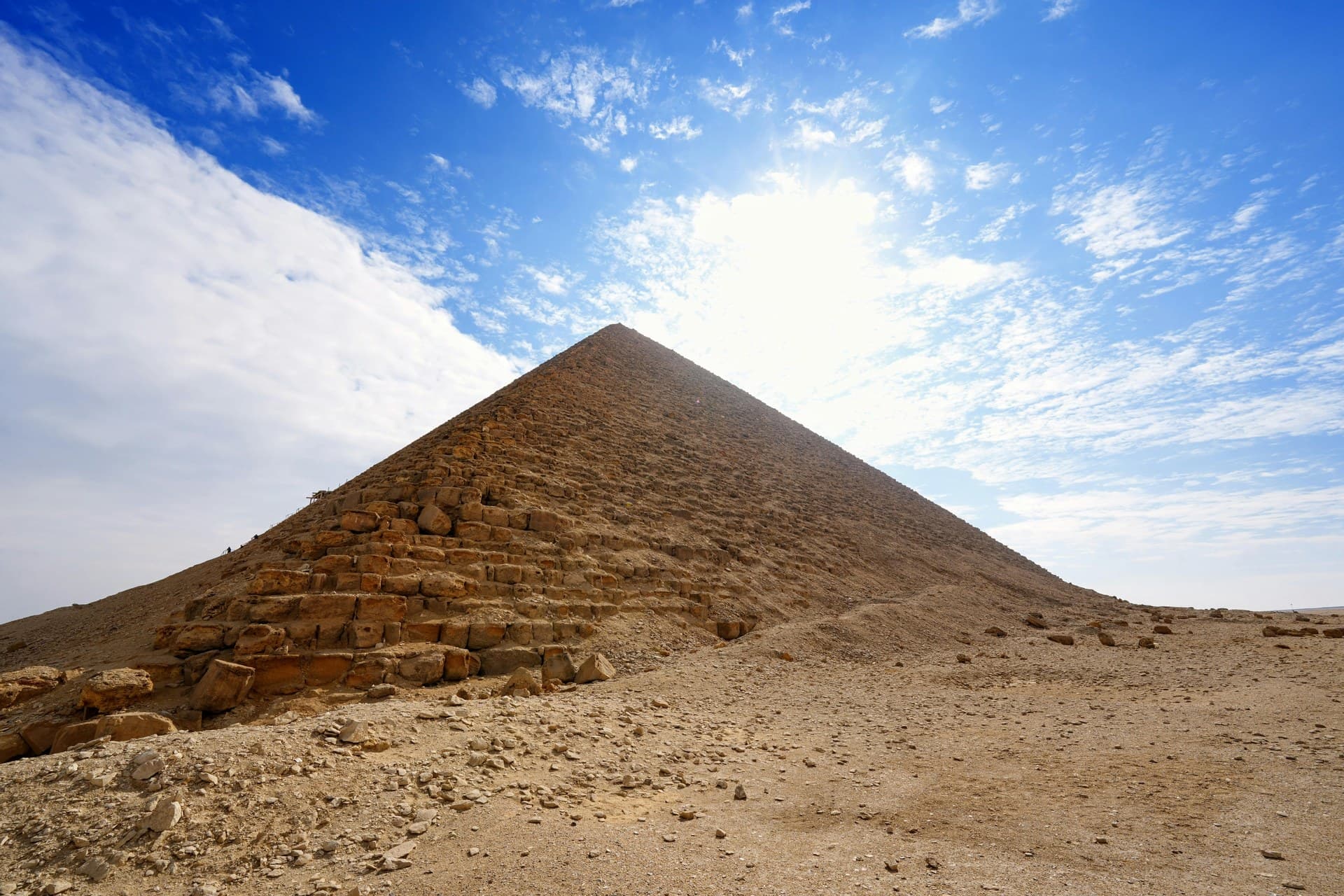
Sneferu, first king of the Fourth Dynasty, is credited with more pyramid masonry than any other Egyptian ruler — the two at Dahshur plus the pyramid at Meidum. That single reign is where the form was resolved.
The Bent Pyramid retains more of its outer casing than almost any other Egyptian pyramid, which is why its surface looks so much smoother than Giza's. It also has an unusual second entrance on its western face, and a satellite pyramid beside it.
Both monuments sat inside a restricted military zone and were only opened to visitors in 1996, which is part of why they remain so lightly visited.
Some seven centuries later the Middle Kingdom came back to the same desert strip. Amenemhat II, Senusret III and Amenemhat III all built pyramids at Dahshur, on the lower ground towards the cultivation. The last of them was raised on a mud-brick core that settled and cracked, and survives as the dark eroded mass known as the Black Pyramid.
Excavation here has been slow and rewarding. Jacques de Morgan, digging beside the Middle Kingdom pyramids in the 1890s, found the royal jewellery now displayed in Cairo as the Dahshur treasure. Ahmed Fakhry cleared the Bent Pyramid's valley temple in the 1950s, and the pyramid's own interior was not opened to visitors until July 2019.