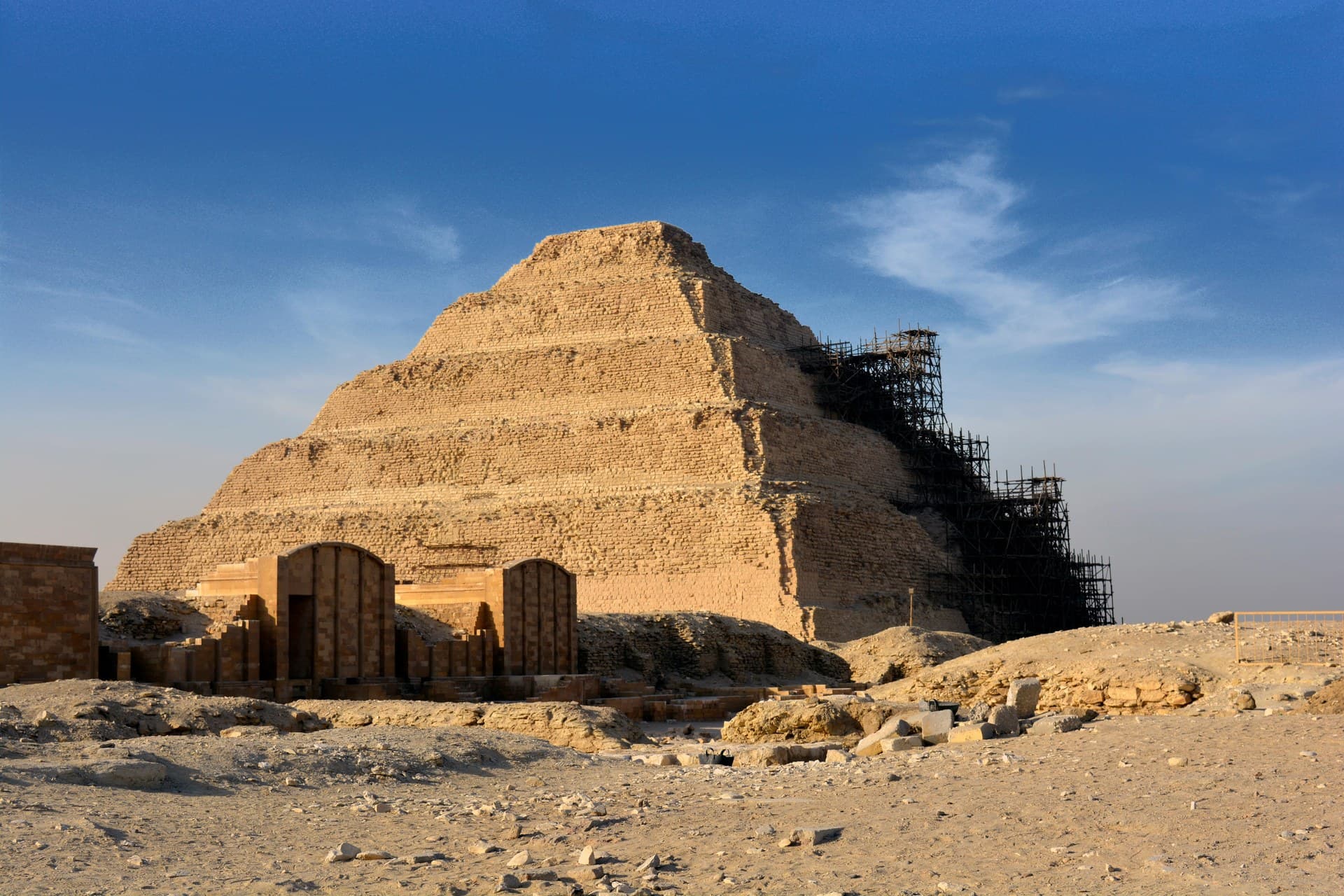
Djoser's complex was built in the 27th century BC and is traditionally credited to Imhotep, his chief official — one of the very few non-royal Egyptians whose name survived to be worshipped as a god in his own right.
The site did not stop there. Saqqara kept receiving burials for over three thousand years, through the Old Kingdom, the New Kingdom, the Late Period and into Ptolemaic and Roman times. That long occupation is why excavation here still produces new discoveries almost every season, including large caches of sealed coffins found in recent years.
The Serapeum, a rock-cut gallery of enormous granite sarcophagi that held the mummified Apis bulls, was cleared in the 19th century by Auguste Mariette. The scale of the boxes — each cut from a single block and weighing many tonnes — is the thing visitors remember.
A niched limestone wall roughly 545 metres by 275 enclosed the whole precinct, with fourteen false gateways and one real entrance at the south-east corner. The Heb-Sed court chapels inside were built solid — stone copies of reed and timber buildings, never meant to be entered.
Much of what stands was put back by hand. Jean-Philippe Lauer, a French architect, arrived in 1926 and spent some seventy years re-erecting Saqqara's fallen blocks; the entrance colonnade is largely his. The pyramid itself was stabilised from 2006 and its interior reopened in 2020.