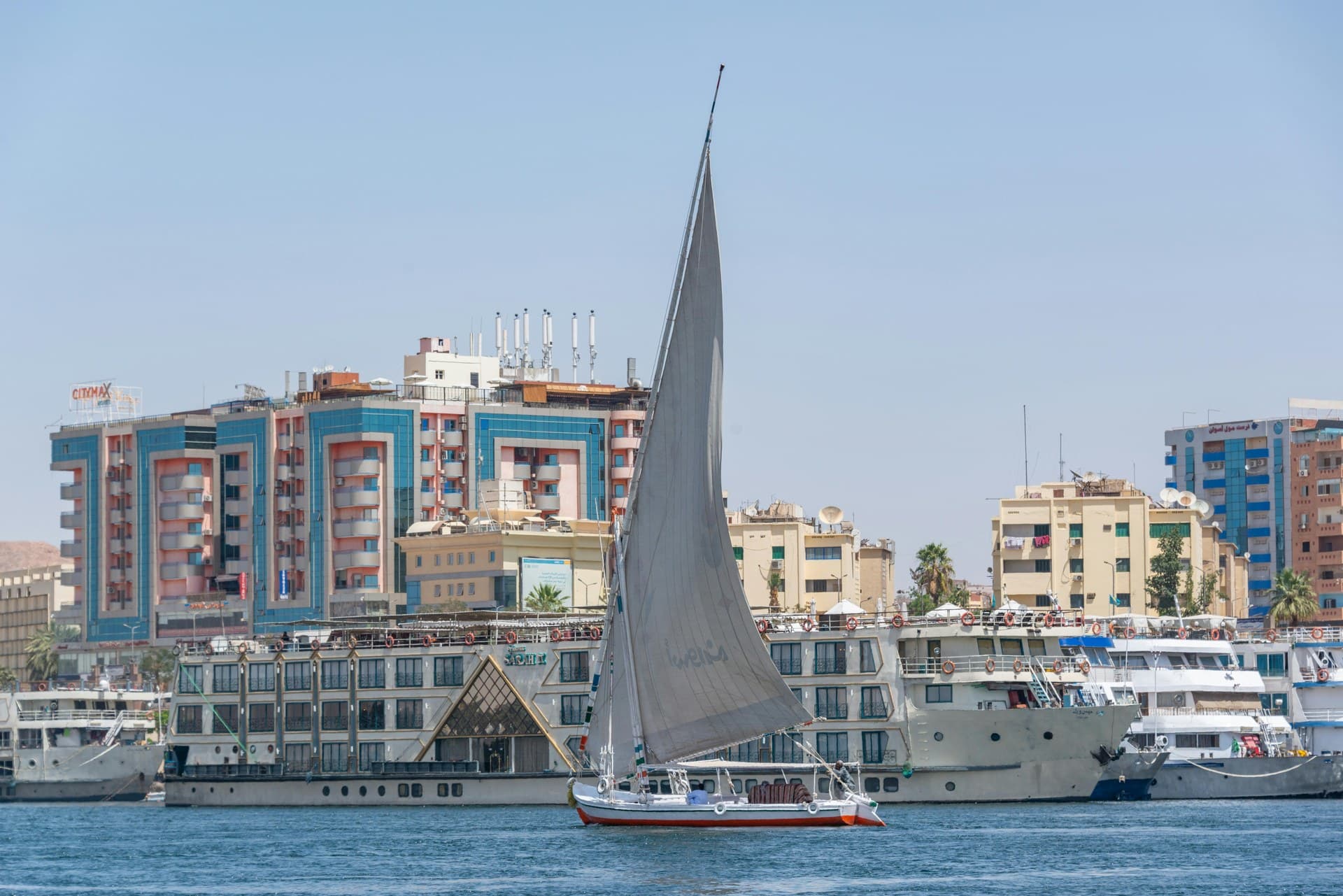
Almost every Egypt itinerary you will be shown includes a Nile cruise, and almost nobody explains what you are actually choosing. Here is the honest version.
What a cruise actually solves
Luxor and Aswan are about 200 kilometres apart, with Edfu and Kom Ombo between them. On land that is a long driving day, or two shorter ones with an awkward overnight in the middle.
On a boat, that same distance is the pleasant part of the trip. You sleep in one bed for four or five nights, you unpack once, and the temples arrive at the boat rather than the other way round. The river itself — the flood plain, the villages, the hard line where green stops and desert begins — is the thing you would otherwise drive past.
That is the whole argument, and it is a strong one.
What a cruise costs you
Timing. Cruise boats moor in the same places on the same schedule, and everyone disembarks at once. That means Edfu at nine in the morning with fifteen other boats' worth of passengers, and it means you see sites when the boat is there rather than when the light or the crowds are best.
Flexibility. If you want to spend four hours at Medinet Habu because you are enjoying it, you cannot — the boat sails.
And the shore excursions are timed to the group. A land-based traveller with a driver can be at the Valley of the Kings at opening and back at the hotel before the coaches arrive.
When a land tour is the better choice
Choose land if you are a photographer, if you want early or late light, if you have been to Egypt before, or if the idea of a fixed daily schedule is the opposite of a holiday to you.
Choose land also if you want the sites the boats do not stop at — Dendera, which is the best temple ceiling in Egypt and is not on the cruise route, or Medinet Habu, which the coaches largely skip.
Our 10 Day Private Egypt Tour and the rest of the tour packages can be run either way — the cruise is a component, not a requirement.
The third option: a dahabiya
A dahabiya is a small sailing boat, typically six to twelve cabins, that runs the same stretch of river. It moves under sail and tow rather than engine, it moors at sandbanks and villages the large boats cannot reach, and it carries a tenth of the passengers.
It is slower, it costs more per night, and there is no pool or evening entertainment. In exchange you get a stretch of the Nile most visitors never see and temple visits without three hundred other people.
If the thing putting you off a cruise is the size of the boats, this is the answer, and it is available on our dahabiya sailings.
Practical points that decide it for most people
A few things worth knowing before you choose:
- Direction. Luxor to Aswan is upstream and usually one night longer than the reverse. Aswan to Luxor is faster and often cheaper.
- Length. Three nights covers Edfu and Kom Ombo. Four to five nights adds time in Luxor or Aswan at either end and is the more relaxed choice.
- Site tickets. Temple admissions are often NOT included in the cruise fare. Check what your programme actually covers.
- Boat, not stars. Nile boats vary enormously within the same nominal rating. Ask for the vessel's name and look it up rather than booking a category.
- An hour on a felucca at Aswan is worth doing whichever option you choose. It costs very little and it is the best sailing on the river.