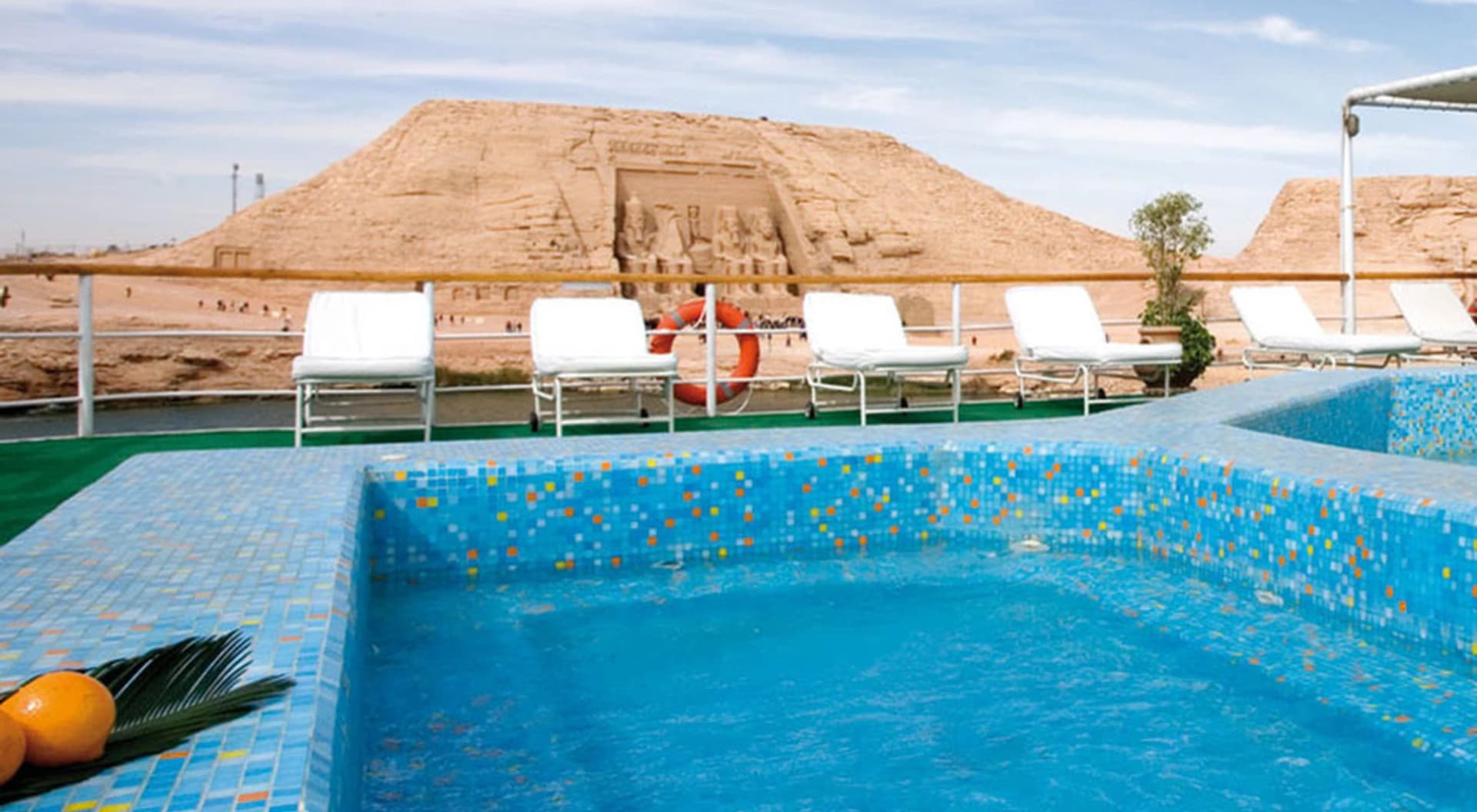
Lake Nasser exists because the High Dam does: a reservoir stretching some five hundred kilometres south from Aswan into Sudan, one of the largest on earth. When it filled, it drowned ancient Nubia — and the international campaign that saved the region's temples moved them to higher ground along the new shoreline — most dismantled and rebuilt block by block, Abu Simbel itself cut free of the living rock.
That rescue wrote the cruise route. The boats call at those regrouped temples — Kalabsha near the dam, the clustered sites of Wadi el-Seboua and Amada along the empty middle reach — before the finale at Abu Simbel, which is itself the most famous of all the rescued monuments. Between the stops there is water, desert shore, and essentially nothing else: no towns, no traffic, no other boats in sight.
How it actually works
Sailings run between Aswan and Abu Simbel over three to four nights, in either direction, on a small fleet — a fraction of the boats that work the Luxor–Aswan reach. Our three are the Prince Abbas, the Omar El Khayam and the Lake Nasser Cruise itinerary, all four-day shapes; the wider category lives on our Lake Nasser page.
The prize is the ending. Boats moor within sight of Abu Simbel, which means you can be at the temples in the early evening and again at opening — before and after the fly-in day trips — and some sailings put the Sound and Light show on the schedule. Day visitors get a brief, crowded midday window; lake passengers get the site nearly alone.
Who it suits — and who it does not
This is a second-trip cruise, or a first trip for travellers who prize emptiness over abundance. The temples are wonderful but fewer and smaller than the Luxor–Aswan parade, the shore is uninhabited desert, and the days are quiet by design. If that description reads as a warning, take the classic cruise; if it reads as the whole point, very little in Egypt matches it.
It also pairs, rather than competes, with the river: Cairo, then Luxor to Aswan by water, then the lake to Abu Simbel is the fullest Nile journey Egypt currently offers — the whole river, source-ward, in one line.