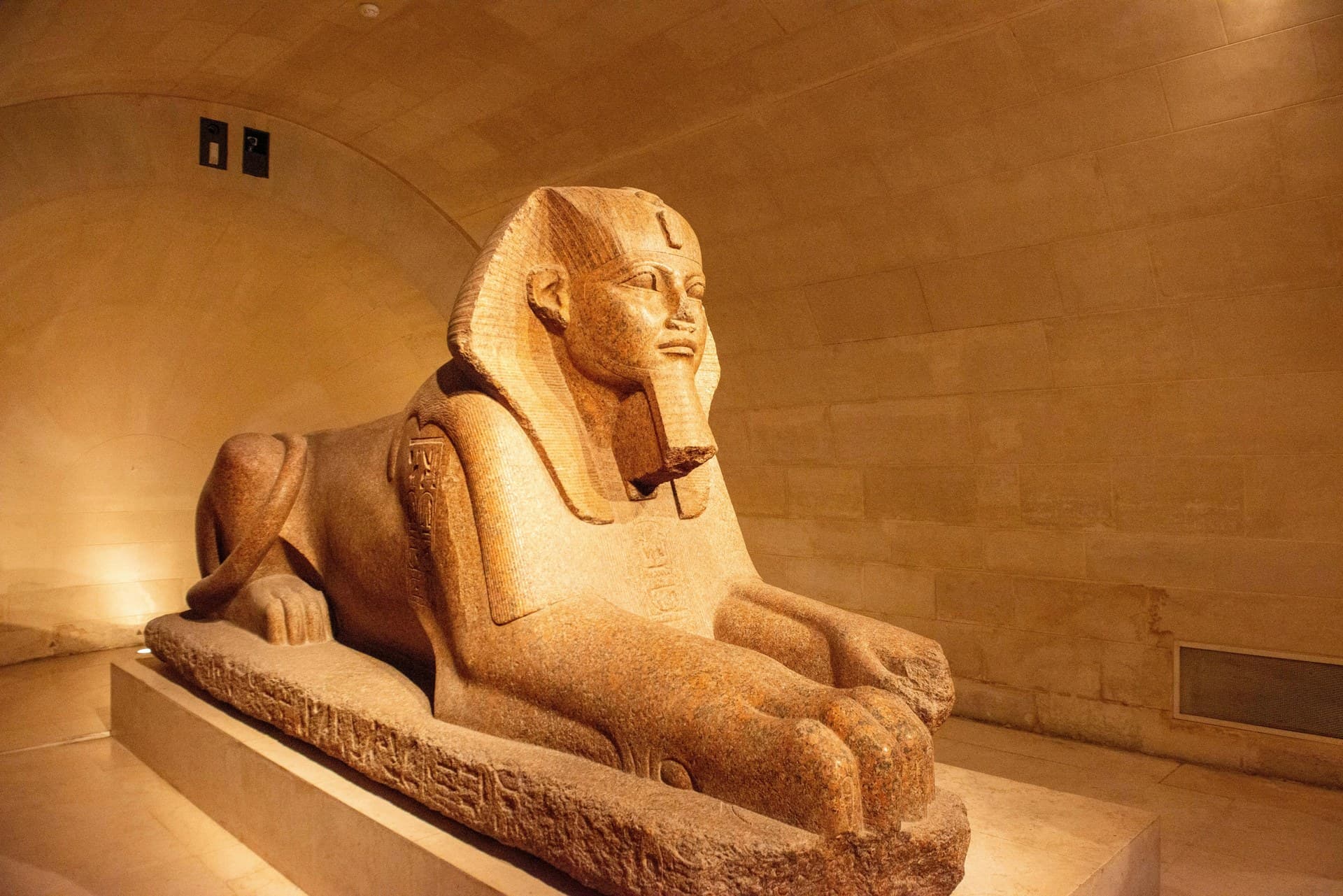
The Grand Egyptian Museum sits on the desert plateau at Giza, within sight of the pyramids. It was decades in the building, and the scale of it is the first thing that registers — the entrance hall alone holds a colossal statue of Ramesses II with room to spare above his head.
It is worth going. What is worth arguing about is how long you give it.
What is actually in it
The Tutankhamun galleries are the reason most people come, and they are the strongest single argument for the museum. For the first time the entire contents of the tomb are displayed together — not a selection, the whole find, thousands of objects, laid out in something close to the order they were packed in. Seeing the burial as an assemblage rather than as a highlights reel changes what it means.
Beyond that, the collection runs the whole span of Egyptian history in a single chronological sweep, which the old museum never managed. The grand staircase is lined with royal statuary and climbs towards a window that frames the pyramids at the top — the one piece of museum theatre in the building, and it works.
There is also space, which sounds trivial and is not. Objects that were crammed three deep in dusty cases for a century now have room, light and labels.
How long it really takes
Two hours gets you Tutankhamun and the staircase and nothing else. That is what most package itineraries allow, and it is why people come out saying it was crowded and rushed.
Half a day is the honest minimum. A full day is not excessive if you like museums, and there is enough food and seating in the building to make that bearable.
If your trip is six days or fewer, accept that you are doing the highlights. From eight days upward there is room to give it a proper day.
Does it replace the Egyptian Museum on Tahrir?
No. A great deal moved, but the Egyptian Museum in Tahrir Square still holds a very large collection, and it holds it in a nineteenth-century building that is itself part of the history of Egyptology.
The two are different experiences. The new museum is curated, spacious and explained. The old one is dense, idiosyncratic and occasionally overwhelming, with objects that have not moved in a hundred years. People who love one often prefer the other.
If you only have time for one, take the new museum on a first visit. Come back for Tahrir.
Who should skip it
- Anyone on a trip of four days or fewer — you will be choosing between the museum and something else, and the plateau itself should win.
- Travellers who genuinely do not enjoy museums. It is a very good museum, but it is still a museum, and Egypt has open-air alternatives.
- Families with small children, unless you go in with a short list and no ambition to see the rest.
Practical notes
- It is at Giza, not in central Cairo — plan it with the plateau, not with Khan el-Khalili.
- Go at opening. It is busiest in the middle of the day, and the Tutankhamun galleries are the busiest part of it.
- Check current ticketing and any timed-entry arrangements before you travel; they have changed more than once since opening.
- There is a great deal of walking on hard floors. Wear what you would wear to a site.