Attraction

Beni Hasan

Middle Kingdom tombs cut high into a cliff in Middle Egypt, painted with wrestling, hunting and workshops instead of gods.

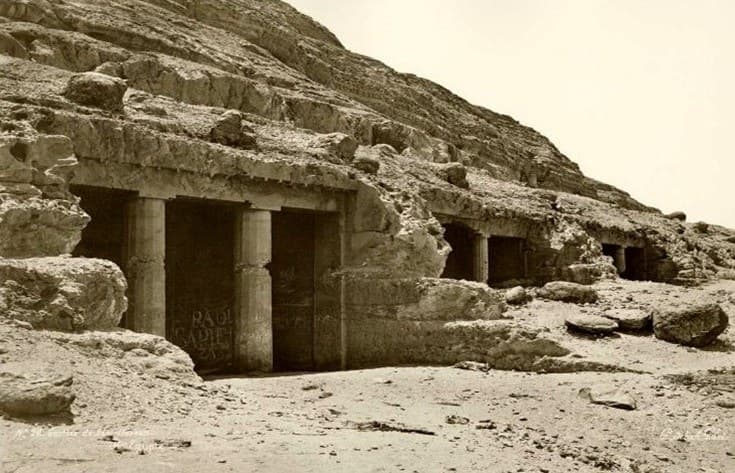
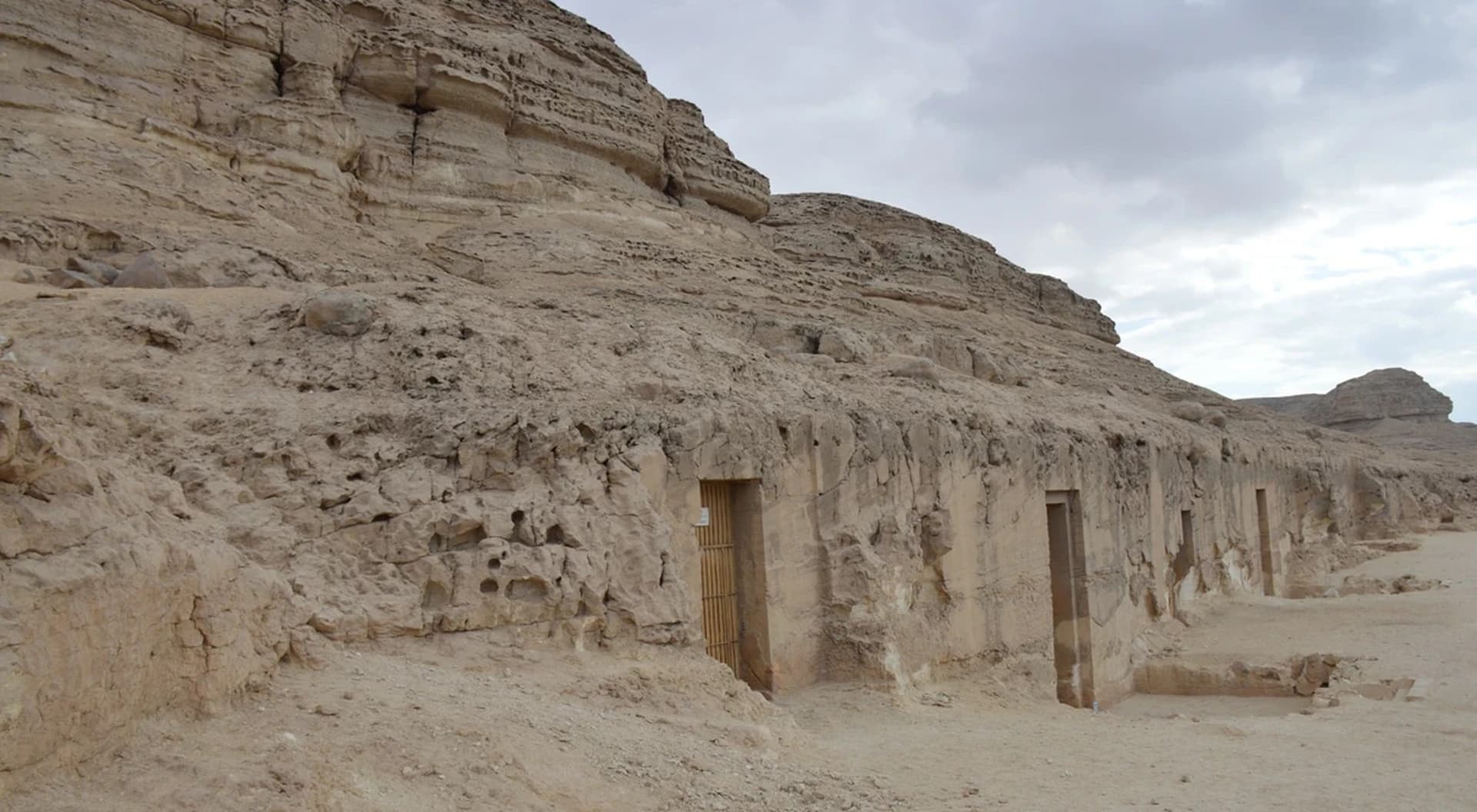
The limestone cliff at Beni Hasan with the dark entrances of its rock-cut Middle Kingdom tombs cut into the face
Archaeological siteMiddle Egypt

Overview

Beni Hasan is a row of rock-cut tombs high in a limestone cliff on the east bank of the Nile in Minya governorate, in Middle Egypt. A stair climbs from the road to a terrace with the tomb entrances along it.

Thirty-nine tombs were cut here for the provincial governors of the Oryx nome in the Middle Kingdom. Four are normally open.

Why visit Beni Hasan

What is painted on the walls is unlike almost anything in Luxor. These are not gods and afterlife texts. They are daily life at close range: metalworkers and potters at their benches, flax being harvested, boats being built, cattle counted, women weaving, musicians, dancers, board games, and a full-scale hunt in the desert.

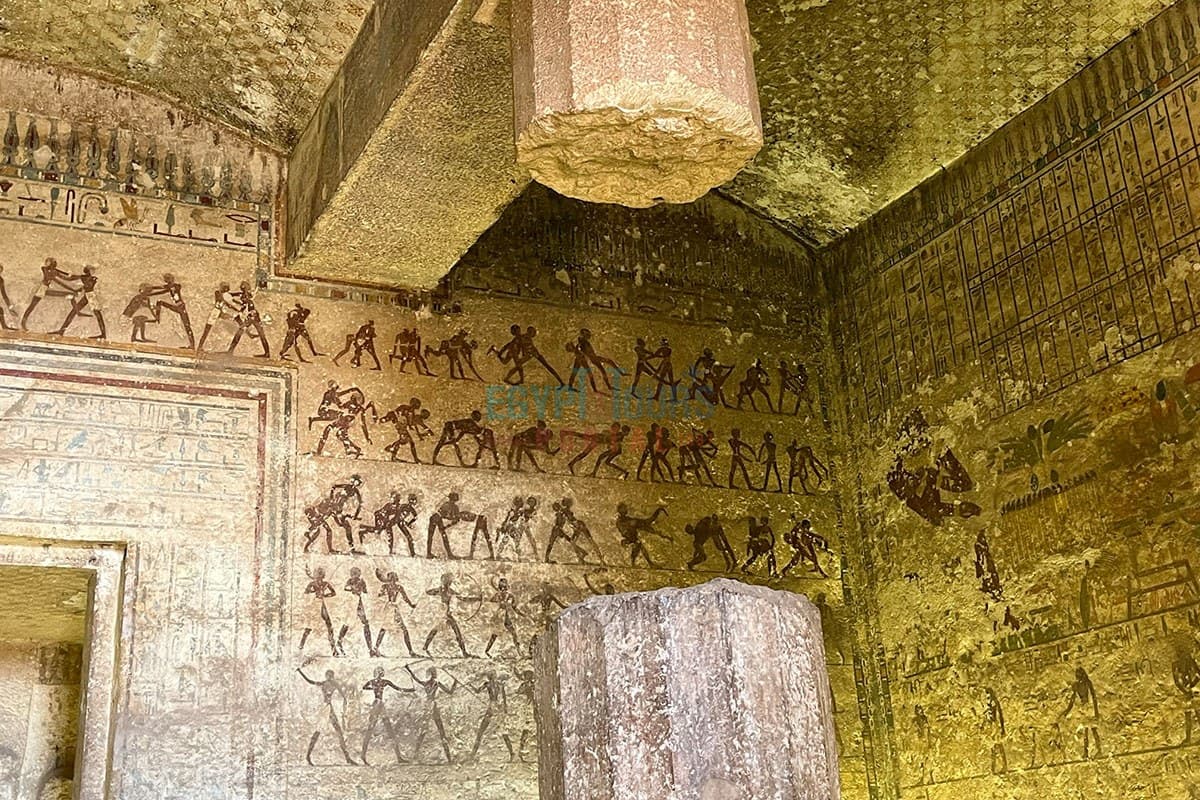
The wrestling walls are the famous part. In the tombs of Baqet III and Kheti, hundreds of pairs of wrestlers are painted in rows, each pair in a slightly different hold, the two figures picked out in contrasting colours so you can follow the limbs. Read in sequence they work like a movement study, and they are the best surviving evidence for how the sport was actually done.

There is also the procession in the tomb of Khnumhotep II: a group of people labelled as Aamu, arriving from the eastern desert with their families, their donkeys and their goods, painted in patterned woollen clothing that is nothing like Egyptian dress. It is one of the most-discussed images in Egyptian art, and it is on the wall in front of you.

History of Beni Hasan

The tombs belong to the 11th and 12th dynasties, roughly four thousand years old, and were cut for nomarchs — the hereditary governors who ran the provinces with real independence before the crown reined them in.

Khnumhotep II's tomb is the best dated. His biographical inscription, among the longest private texts of the Middle Kingdom, records how his family gained the governorship, and the caption to the procession dates it to year six of Senusret II, with thirty-seven Aamu bringing black eye-paint. His is the last of the great painted tombs here; across Egypt the monumental provincial governors' tombs fade out within a generation, by the reign of Senusret III.

Their architecture borrows from the living: porticoes with fluted columns cut from the solid rock, sometimes called proto-Doric because they anticipate a Greek form by more than a thousand years.

Two kilometres south, cut into the side of a wadi in the same escarpment, is the Speos Artemidos, a rock-cut chapel of Hatshepsut dedicated to the lioness goddess Pakhet, carrying an inscription in which she describes repairing the damage left by the Hyksos.

Percy Newberry published the painted tombs for the Egypt Exploration Fund in 1893 and 1894, in the Archaeological Survey series, with F. Ll. Griffith contributing the later volumes on the hieroglyphs and technical detail in 1896 and 1900. One of the draughtsmen tracing the walls for Newberry was Howard Carter, then seventeen and new to Egypt. John Garstang followed, clearing hundreds of ordinary shaft burials on the slope below between 1902 and 1904 and recovering the wooden models of boats, granaries and workshops buried with them.
What to see at Beni Hasan

  • The wrestling sequences in the tombs of Baqet III and Kheti
  • The procession of Aamu arriving in the tomb of Khnumhotep II
  • Craft workshops, harvests and hunts painted at eye level
  • Rock-cut porticoes with fluted proto-Doric columns
  • The view over the Nile valley from the terrace outside the tombs
  • A fortress under attack, painted in the same tombs as the wrestling rows
  • The long biographical inscription of Khnumhotep II

Best time to visit Beni Hasan

November to March. The climb is unpleasant in the heat.

Opening Hours and Tickets

Opening hours: Daytime hours with seasonal variation.

A single admission ticket at the site entrance covers the tombs that are open. A photography permit may be charged separately.

Opening hours and ticket prices may change. Please confirm the latest details before visiting.

How to get to Beni Hasan

On the east bank in Minya governorate, about 20 kilometres south of Minya city and roughly four hours by road from Cairo. Reached with a driver; travel in the region may be escorted.

Tours that include Beni Hasan

Egypt and Jordan Itinerary 7 Days

Egypt and Jordan Itinerary 7 Days

Embark on an extraordinary 7-day adventure through two of the world’s most captivating destinations—Egypt and Jordan. Witness the timeless grandeur of the Pyramids of Giza, explore the treasures of the Grand Egyptian Museum, and wander through the ancient streets of Old Cairo. Then, cross into Jordan to marvel at the rose-red city of Petra, float in the mineral-rich waters of the Dead Sea, and stand atop Mount Nebo where history and faith intertwine. This journey blends cultural discovery, historical exploration, and modern comfort into one unforgettable experience.

Best 6 Days Egypt Itinerary

Best 6 Days Egypt Itinerary

Experience the timeless beauty of Egypt on this 6-day adventure through its most iconic destinations. Begin in Cairo with a guided exploration of the Pyramids of Giza, the enigmatic Sphinx, and the remarkable Grand Egyptian Museum. Continue to Luxor to uncover the grandeur of the East and West Banks, including the magnificent Karnak and Luxor Temples, the Valley of the Kings, and the Temple of Queen Hatshepsut. Conclude your journey in Aswan, where you’ll visit the serene Philae Temple, the impressive High Dam, and immerse yourself in the colorful culture of a Nubian Village.

08 Days Dubai and Egypt Vacation Package

08 Days Dubai and Egypt Vacation Package

Embark on an extraordinary 8-day adventure that blends the timeless heritage of Egypt with the futuristic allure of Dubai. Begin your exploration in Cairo, where the Great Pyramids of Giza, the Grand Egyptian Museum, and the Egyptian Museum reveal the splendor of ancient civilization. Then, fly to Dubai to experience a city that harmoniously merges tradition and innovation — from its historic souks and cultural landmarks to its glittering skyline and desert landscapes. This journey offers a perfect balance of history, luxury, and modern excitement, creating memories that will last a lifetime.

10 Days Egypt and Jordan Tours with Nile Cruise

10 Days Egypt and Jordan Tours with Nile Cruise

Experience the essence of two ancient civilizations on this 10-day Egypt and Jordan tour with a Nile Cruise. Journey through Egypt’s timeless wonders—from the Great Pyramids and the Sphinx to the temples of Luxor and Aswan—while enjoying the serene beauty of the Nile aboard a luxury cruise. Then, cross into Jordan to uncover the rose-red city of Petra, the Roman ruins of Jerash, and the tranquil waters of the Dead Sea. This itinerary blends history, culture, and comfort for travelers seeking an extraordinary adventure across two legendary lands.

15 Days Egypt and Morocco Tour Package

15 Days Egypt and Morocco Tour Package

Embark on a remarkable 15-day adventure that unites the timeless heritage of Egypt with the colorful charm of Morocco. This exclusive itinerary is designed for travelers who seek cultural depth, comfort, and personalized service. Begin your journey in Egypt, where you’ll stand before the Great Pyramids and Sphinx, cruise the Nile aboard a 5-star vessel, and explore the temples of Luxor and Aswan. Then, continue to Morocco to discover the imperial cities of Rabat, Fez, and Marrakech, each offering a unique blend of history, art, and architecture.

7 Days Egypt Tour in December

7 Days Egypt Tour in December

Embark on a 7-day adventure through Egypt during the pleasant month of December, when the weather is mild and the crowds are fewer. Discover the timeless wonders of Cairo, including the Great Pyramids of Giza and the Grand Egyptian Museum, before flying south to Aswan and Luxor. Cruise along the Nile aboard a five-star vessel, visiting ancient temples and marveling at the beauty of Egypt’s landscapes. This journey blends history, culture, and comfort for an unforgettable winter escape.

Travel Tips Before Visiting

It is a climb. The tombs sit well above the road and the stair is long and exposed. Take water and do it early. Bring a torch. The paint is fine-lined and the interiors are lit poorly or not at all. Travel in Middle Egypt often involves a police escort or convoy. That is normal, it is arranged by your driver or operator, and it means the day has to be planned rather than improvised. Ask which tombs are unlocked when you arrive. A guardian holds the keys and not all four are always open. Flash is usually barred, and it would not help anyway. The decoration here is flat painting on smoothed plaster rather than carved relief, so what you want is even light on the drawn line. Hold the torch away from the lens and move it about rather than firing light straight at the wall, which flattens the paint and throws glare off the plaster.